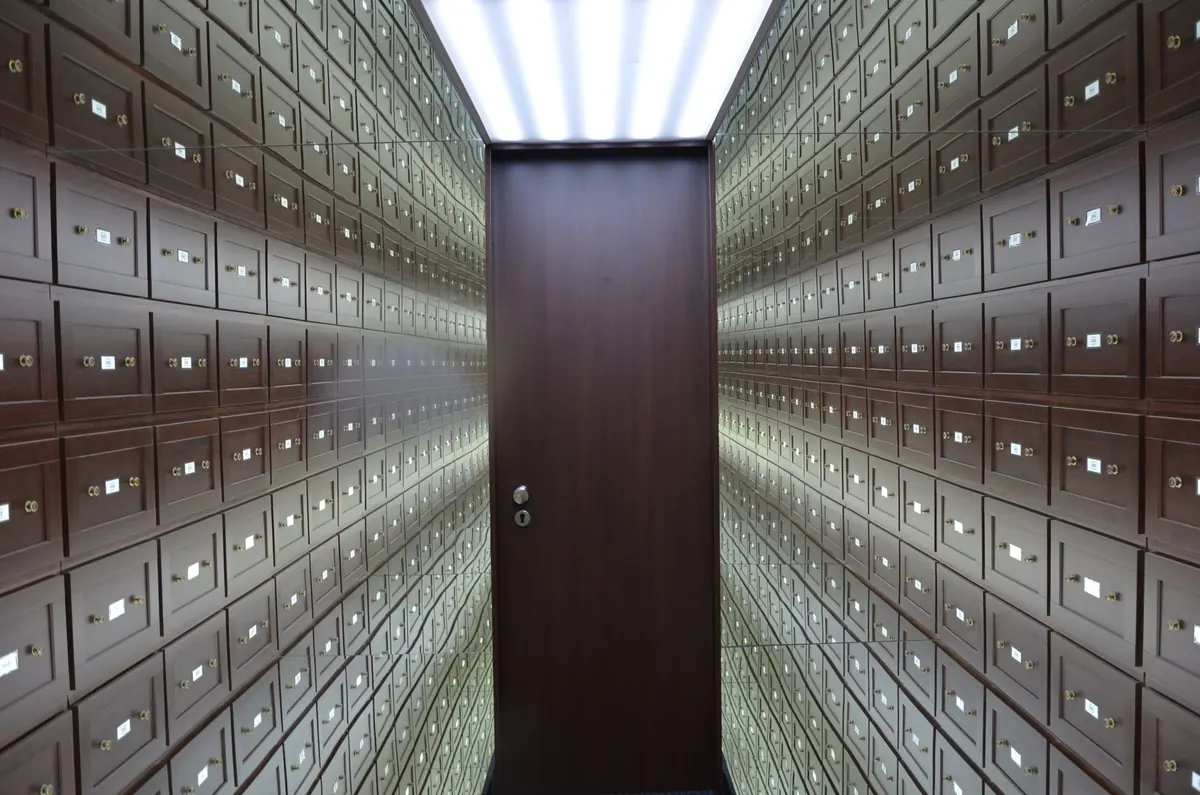
Standing in front of an open vault door, most people see two things: a thick steel slab and a combination dial. What sits behind the face is closer to a clock, a trap, and a lock all arguing with each other. A modern door is a stack of independent systems — boltwork, lock package, relockers, hard plate, and a body built to resist cutting and heat. Every layer assumes the layer in front of it will eventually fail, and each one is arranged so that failure still doesn't get the door open.
Understanding that sequence is useful whether you're specifying a vault, servicing one, or just curious about why a door the size of a refrigerator can cost more than a house.
The easiest way to picture a vault door is from the outside in. Attackers work in the same direction, so the door gives up its time in that order:
None of these systems shares a brain with the others. That's the point. A drill that defeats the hard plate still has to deal with whatever is sitting behind it, and a relocker that fires before the bolts are drawn back keeps the door shut no matter how neatly the lock was beaten.
A mechanical vault door doesn't hinge open like a cabinet. The bolt carriage is a heavy steel frame that slides when the handle turns, pushing round bolts outward into the door frame on the hinge side, the opening side, and often the top and bottom. On larger doors those bolts can be an inch or more in diameter, and several of them engage at once. Cutting one bolt doesn't help; the carriage has to move.
Traditional three-wheel mechanical locks are still common in bank vaults because they have no batteries, no firmware, and no way to be opened remotely. They're vulnerable to two things: manipulation (a patient hand feeling for the contact points of each wheel) and drilling at the precise spot where the fence drops into the wheel pack. Modern electronic locks trade that physical craft for time-delay programming, audit trails, and dual-custody codes.
A time lock is a separate mechanism that physically blocks the lock from releasing during set hours, historically driven by clockwork and now usually by electronics. It serves two purposes. First, it keeps the vault sealed overnight and on weekends, when nobody needs in. Second, and more importantly, it removes the option of coercion: staff can't open the door at 2 a.m. even if someone is standing next to them insisting they should. A time delay is a smaller version of the same idea — a few minutes of forced waiting after the correct combination is entered, long enough for a robbery to lose its momentum.
A relocker is the door's immune response. It's a spring-loaded bolt held back by a trigger, and its only job is to slam into the boltwork and lock the door permanently when it senses interference. Once it trips, the vault is a steel box until a safe technician drills it open and rebuilds the mechanism.
The classic design uses a tempered glass plate mounted behind the lock. Drill through it, punch the lock, or crack it with a torch, and the plate shatters, releasing the spring. Some doors use multiple plates and multiple relockers so a single clean hole can't be threaded past them.
Heat-sensitive triggers fire when the door is attacked with a torch. Vibration and pressure triggers do the same for hammering, hydraulic spreading, and explosives. These are deliberately crude devices — a melted alloy pin or a sheared catch — because crude is reliable.
Directly in front of the lock sits the hard plate, often manganese steel or a boron-based alloy, sometimes with carbide chips mixed in to grab and snap drill bits. Many doors use two plates set at opposing angles so a bit that's fed straight in wanders off course.
The body does the same job at a larger scale. Rated doors are tested against actual tools under recognised standards, which is what TL and TRTL ratings on a door plate refer to — the letters describe resistance to tools, torches, or both, and the number describes how many minutes of working time the door is expected to survive. A high rating doesn't mean a door can't be opened. It means the attempt takes long enough that the people doing it get caught, run out of equipment, or give up.
Notice how much of that list is about time rather than defeating anything outright. Vault design is a scheduling problem disguised as a hardware problem.
If you're responsible for a vault, the mechanisms above should shape a few habits. Keep a service schedule and use a licensed safe technician — combination changes, lock swaps, and relocker resets are not jobs for a general locksmith or a maintenance crew with a drill. Keep a written record of the door model, the lock type, and whether relockers have ever been tripped, because that history changes how a technician approaches the next service. Store the combination and any dual-custody codes separately from the vault room, and review who has access at least annually.
If you're buying, ask which ratings the door actually carries and what they were tested against, then match that to your realistic risk and insurance requirements. And never attempt to open a vault you don't own or aren't authorised to access — beyond the legal exposure, an amateur attempt usually ends with a tripped relocker and a far more expensive repair than a scheduled service call.
Photo: Ehtiram Mammadov / Pexels
A practical introduction to vault entry systems: how credentials, dual control, and turnstiles work together, and...
A practical guide to choosing a CCTV retention window: how storage, legal expectations and real-world detection...

A seasonal safe maintenance guide for winter: control humidity with desiccants, inspect door gaskets, replace lock...


Monitoring the world's most secure vaults..
